July 7, 2026
Mobility
Power Electronics brings AI-driven control to EV charging operations through Power On Support
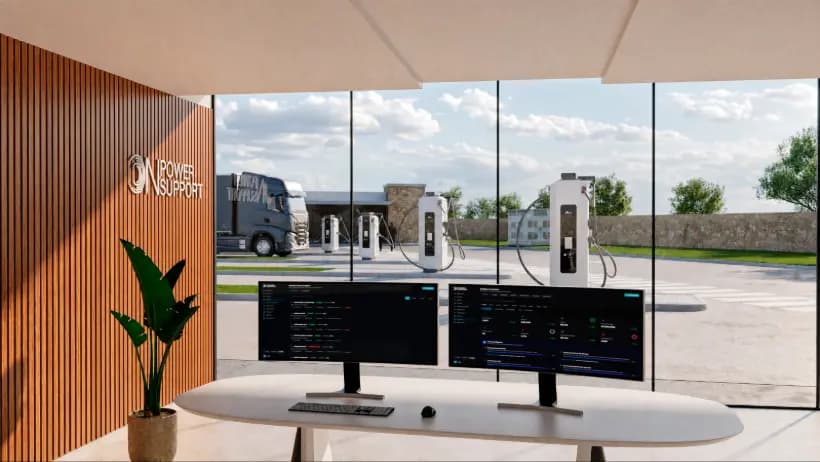
As electric vehicle charging networks grow in scale and complexity, infrastructure performance is no longer defined solely by charger power. For operators and asset owners, uptime increasingly depends on the ability to monitor fleets in real time, detect issues early, manage assets remotely, and turn operational data into decisions.
In this context, Power Electronics is expanding the capabilities of Power On Support, its 24/7 after-sales service, with new AI-powered functionalities for EV charging infrastructure. Already designed to give customers easy access to equipment information, assistance requests, service updates, and full service history from any device, Power On Support now also incorporates advanced monitoring, operations, and predictive maintenance capabilities.
Showcased as part of the company’s mobility portfolio at The smarter E Europe 2026 in Munich, this enhanced functionality reflects a broader shift in the market: EV charging infrastructure now requires not only robust hardware, but also intelligent digital control.
Power On Support evolves into a more advanced control environment
With these new capabilities integrated into Power On Support, Power Electronics can access detailed information on its charging assets, including equipment status, location, configuration, and key features. Through a single digital environment, they can monitor charger fleets with real-time visibility into charging details, equipment status, system events, and other relevant operational values.
This transforms charging management from a reactive process into a more active operational model. Instead of waiting for an issue to interrupt service, the company can continuously track charger conditions and network performance from a centralized control environment.
AI-powered predictive maintenance and KPI-driven improvement
Power On Support also introduces an advanced layer of infrastructure intelligence through AI-powered capabilities. By combining real-time monitoring with operational data analysis, the system supports predictive maintenance logic that helps identify anomalies, recurring patterns, and early signs of failure before they result in downtime.
This is especially relevant in charger fleets, where availability directly affects network reliability, customer experience, and revenue. Beyond maintenance, these new functionalities also enable the collection of operational KPIs that support performance analysis and continuous improvement.
In this sense, Power On Support does more than support installed equipment. It also creates a feedback loop between charger operation, service efficiency, and product evolution, helping Power Electronics strengthen both charging performance and future product development.
Remote capabilities for more reliable charging operations
Another important dimension of these new functionalities within Power On Support is their remote capability. Power Electronics can configure charger connection settings, manage OCPP communication, oversee system parameters, and access remote software upgrade information. These functions help reduce operational complexity while increasing control over geographically distributed charging networks.
For charging infrastructure owners and operators, this means Power On Support now covers a broader range of needs within a single digital environment: equipment information, service requests, real-time monitoring, historical reporting, incident handling, remote configuration, and continuous optimization.
A new digital focus for Power Electronics’ e-Mobility division
Power Electronics is reinforcing a new digital dimension of its e-mobility offering by combining charging infrastructure with AI-powered software operations. This approach was showcased at The smarter E Europe 2026 in Munich, where the company highlighted how digital intelligence is becoming a key layer in EV charging infrastructure.
Power Electronics exhibited the Standalone NB 400, a charger designed for flexible high-power charging. It delivers up to 400 kW, operates within a 150–1000 V voltage range, and supports simultaneous charging for two vehicles.
The company also showcased the NBSK 1920, a scalable turnkey charging station developed for high-demand environments. Depending on configuration, it supports MCS and CCS-compatible outputs and up to 24 outputs, making it suitable for charging hubs and more complex deployment models.
Completing the portfolio on display, the MCS (Megawatt Charging System) Solution was presented as Power Electronics’ answer for ultra-fast charging applications. Designed for next-generation heavy-duty transport, it supports up to 1500 A at 1000 Vdc and reflects the growing importance of megawatt charging in future mobility infrastructure.
Together, these solutions illustrate how AI-powered fleet monitoring, predictive maintenance, and intelligent issue management can complement high-power, scalable, and megawatt charging technologies within a single EV infrastructure strategy.
Share article